
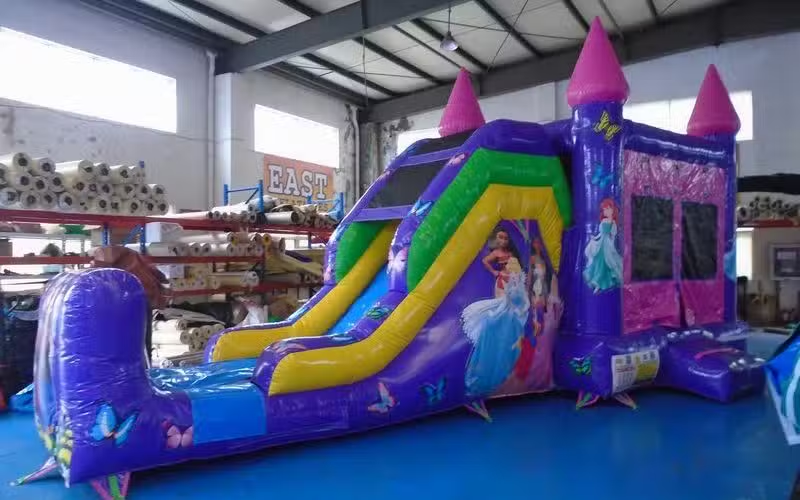
In the Australian jumping castle hire industry, your reputation is built on one thing: safety. When you’re packing up after a busy weekend in the sun, it’s tempting to overlook a tiny, 2cm snag on a seam or a small puncture on the jumping floor. You might think, “It’s just a slow leak, the blower can handle it.”
However, in the world of high-pressure commercial inflatables, there is no such thing as a “minor” tear. Under the right conditions, a small hole can transform into a catastrophic blowout in seconds. Here is the science behind why you should never ignore a tear, and how to protect your business and your young jumpers.
1. The “Balloon Effect” and Air Pressure
A commercial jumping castle isn’t just a bag of air; it is a pressurized structure. To maintain the rigid bounce that Aussie kids love, the internal air pressure is constant and significant.
Think of it like a balloon. A small prick in a balloon doesn’t just let air out slowly—the tension of the rubber causes the entire structure to fail instantly. While 0.55mm PVC is much tougher than rubber, the principle of tensile stress remains. When a small tear occurs, the air rushing out at high velocity puts immense pressure on the surrounding threads. If the PVC is aged or of low quality, that tiny hole becomes the “starting line” for a massive rip.
2. Dynamic Loading: The Impact of the Jump
The real danger isn’t the air pressure alone; it’s the dynamic load. When a group of kids is jumping, they are creating sudden, heavy spikes in pressure.
- Every time a child lands, the air inside the unit is compressed and forced toward the weakest point.
- If there is a small tear in a high-traffic area (like the base of a pillar or the centre of the bed), each jump acts like a hammer blow to that hole.
- Eventually, the stitching can’t hold the tension anymore, and the tear “zips” open—resulting in a sudden loss of structural integrity.
3. The Risk of Internal Baffle Failure
Sometimes the tear isn’t on the outside where you can see it. It’s the internal baffles—the walls inside the castle that keep the floor flat—that are the most dangerous.
- If an internal baffle tears, the floor will begin to “bulge” or “bubble.”
- This creates an uneven surface that can cause broken ankles or collisions.
- More importantly, a failed internal baffle puts double the stress on the outer seams. If those seams have even a tiny existing tear, a total blowout is almost inevitable.
4. Australian Weather and UV Degradation
Our harsh Australian UV rays are the silent enemy of PVC. Over years of exposure in the Sydney or Brisbane sun, the plasticizers in the vinyl begin to dry out.
- The Result: The PVC becomes brittle.
- The Blowout Risk: On a new, high-quality unit, a small tear might just stay a small tear for a while. On a UV-damaged unit, the material loses its “stretch.” A tiny snag can turn into a 1-metre-long gash in an instant because the fabric can no longer absorb the energy of the jumps.
5. Liability and AS 3533 Compliance
In Australia, operating a unit with a known defect is a massive legal risk. Under the AS 3533 safety standards, hire operators are required to perform pre-hire inspections. If an accident occurs and it is discovered that the unit had a pre-existing tear—no matter how small—your insurance company may deny the claim. A “cheap fix” today could cost you your entire business tomorrow.
6. How to Identify a “Danger Tear”
Not every scratch is a disaster, but you must know the red flags:
- The Hissing Sound: If you can hear the air escaping from a distance, the hole is already large enough to be a structural threat.
- Frayed Stitching: If the threads around a small hole are starting to unravel, the “zipper effect” is about to happen.
- Bubbling when Wet: During your cleaning process, if you see bubbles forming at a seam, that is a deep-seated leak that needs immediate professional repair.
Summary: Patch it or Pull it
In the jumping castle hire business, “she’ll be right” is not a safety policy. A small tear is a structural vulnerability waiting for a high-pressure moment to fail.
If you find a tear, no matter how insignificant it looks:
- Deflate the unit immediately.
- Perform a professional repair using a PVC patch and high-strength adhesive (like HH-66) or take it to a specialized industrial machinist.
- Never “double-blower” a leaking unit to keep it firm; this only increases the internal pressure and makes a blowout more likely.
By maintaining a fleet of high-quality 0.55mm PVC castles and staying on top of even the smallest repairs, you ensure that the only thing “blowing up” at your next event is the fun.